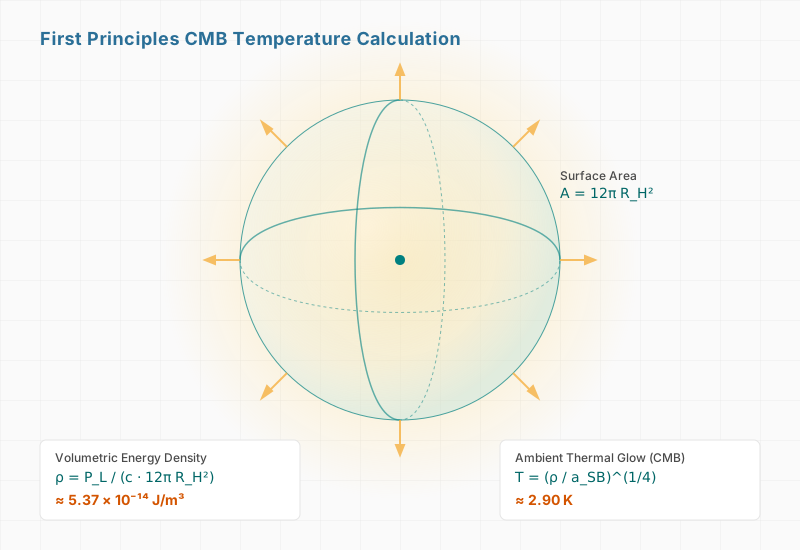
In a discussion with a member of an online cosmology forum, a question came up about how the Emergent Time Framework (ETF) calculates the temperature of the Cosmic Microwave Background (CMB).
This is an interesting question because it involves thinking about how the power flux operates through the manifold, so the problem is, in effect, split into three parts that must each be treated in sequence. In the first part we calculate the total surface area, then we consider the power flux that operates through this total surface area and once we have that, we then apply the Stefan-Boltzmann equation to yield the temperature.
In the ETF, because of the three spatial degrees of freedom inherent to the manifold’s geometry, the total effective boundary area is not the standard spherical 

We can model this as a classic surface power-loading problem like this
- Planck Power (
):
- Total Horizon Surface Area (
):
- Resulting Surface Power Flux:


Step 1: Converting Flux to Energy Density
To convert this surface power flux into a volumetric radiation energy density (


To relate this calculation to the current epoch, we use a standard Hubble constant baseline of 


Step 2: Apply the Stefan-Boltzmann Relationship
Next, we map this energy density to a temperature using the standard Stefan-Boltzmann relationship for radiation density, where the radiation constant is defined as:

Substituting our calculated ETF energy density into the temperature equation:


Why the Geometry Matters
Within the ETF, the 
When the cosmic power flux is mapped across this specific, multidimensional boundary surface, the baseline thermal glow of the manifold naturally resolves to 